Easy Trick for Remembering
 So … you want to know how to remember things.
Excellent. You're in the right place. I read every book on the topic I can find. And I am always looking to improve my own memory skills.
Here's a simple fact about improving your memory:
People with excellent memories and memory championship winners are not too different from you. They just use a combination of techniques to enable their minds to memorize things.
You might find it hard to remember names, facts, equations, lists, tasks you need to take care of, a new language, and so on.
But if you follow the right techniques, you can remember almost anything you want. The techniques you'll discover on this page will work for you, no matter how bad you think your memory is.
In this article, I will show you a number of techniques that will help you understand:
- How to remember what you read
- How to remember names
- How to remember lists and things you need to do
- How to memorize things faster
- How to remember something you forgot
… and so on.
There are dozens of techniques and memory tricks, but they can be classified into three approaches:
- Mnemonics for Memory Improvement
- Lifestyle Changes For Memory Improvement
- Other Memory Methods for Improvement
Let's take a look at each. You can read or enjoy this video version of the text by clicking "play" and eliminating all distractions:
>>> Yours Free: A Private Course With Cheat Sheets For Becoming A Memory Master, Starting From Scratch.
How To Remember Things With Mnemonics: 21 Memorization Techniques
Mnemonics are memory techniques that help you to remember things better. They are also the most effective for forming strong long-term memories. Here are a few of the most common mnemonic devices:
1. Memory Palaces
The Memory Palace is the most powerful mnemonic device ever formulated.
If you are a fan of 'Sherlock' – the BBC series, you have seen Sherlock Holmes use his 'mind palace' to remember practically everything. This memorization method isn't just used by fictional detectives. Memory champions swear by the memory palace.
The mnemonic device, also referred to as the 'Method of Loci' or 'Cicero Method' was developed in Ancient Greece.
How does it work?
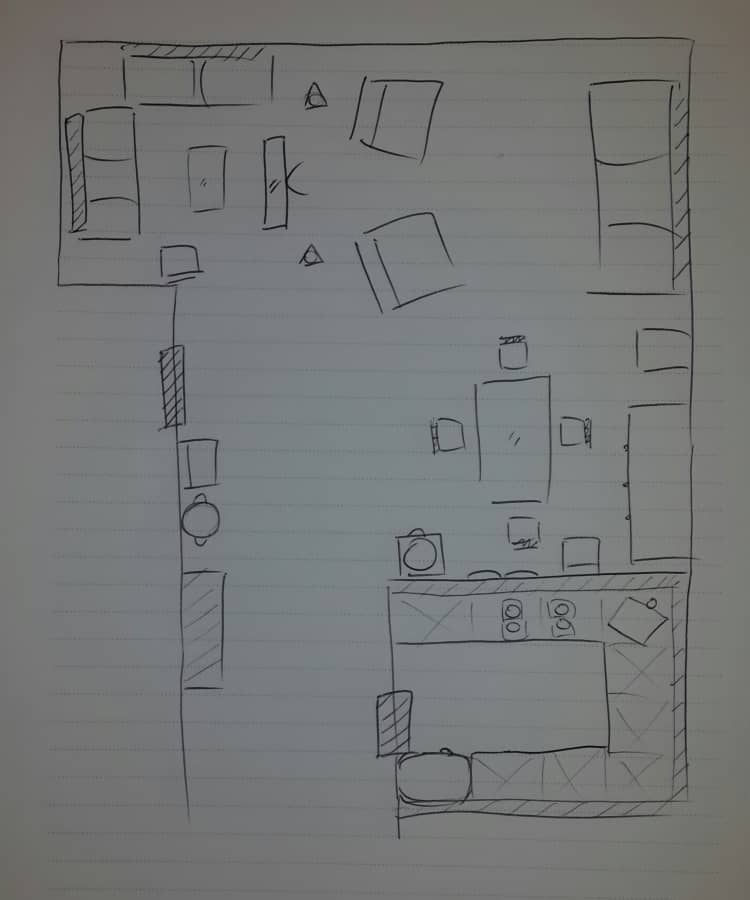
The fundamental concept of the Memory Palace Technique is to associate pieces of information that you wish to remember with parts of a location that you are very familiar with. This location can be your home.
This memorization method begins by visualizing yourself walking through your home and remembering every single detail that you can. It's also a great mental exercise.
However, you necessarily do not need to visualize, and can physically walk through your home too. In fact, the idea of the memory palace is to make use of all your senses – auditory, kinesthetic (touch), and so on.
Associate each item that you wish to remember with a specific object or space in your home. For example, if you are trying to remember a new language, you might want to store all the words related to weather in your wardrobe.
Associating items within your mind with a real physical space helps your brain 'file' important things to remember more easily.
Mind Palaces can be used to remember names, faces, languages, lists, academic material, and pretty much anything under the sun. I talk about the Memory Palace in more detail in this article.
2. Spaced Repetition
It's easier to remember something that you read yesterday than a paragraph you have read a year back. Hermann Ebbinghaus referred to this as the forgetting curve. His research into the psychology of memory observed that we forget most newly acquired information within a few hours or at the most a couple of days.
However, if you reinforce what you learn at regular intervals, it's easier to retain that piece of information from the long-term storage areas of your brain.
The spaced repetition method is all about practicing remembering at the right time.

You do that by reinforcing a bit of information in your mind just when you are about to forget it.
A simple way of applying this memory technique is to use flashcards. You can organize your flashcards into three batches depending on how easy it is for you to remember.
If you remember something clearly, test yourself with the same flashcard within ten minutes, but if you do remember, test yourself at a longer interval.
There are several tools out there that claim to be spaced repetition software, but which are actually not. If you wish to try out spaced repetition, the best approach is to make your own flashcards.
3. Use Chunking to Remember
Chunking is the process of clubbing things together into groups.
For instance, you could try remembering your grocery list according to each shelf in the store.
Or when you are learning a new language, learn words that are related by a strong context, such as breakfast food items, winter clothing, and so on.
The human brain naturally tends to look for patterns, and chunking allows the brain to store information in easy-to-remember packets.
Here are 21 more study tips related to chunking, some of which are a bit unconventional.
4. Expression Mnemonics or Acronyms
You have probably come across this method in school. You create an acronym of the different things that you wish to remember.
If you have taken music lessons, you would remember EGBDF (the treble clef) with the acronym, "Every Good Boy Does Fine."
Another common expression mnemonic you might remember from your school days is HOMES – for the Great Lakes (Huron, Ontario, Michigan, Erie, and Superior).
Acronyms are difficult to forget! There are similar Expression Mnemonics which involve rhymes, songs, and so on.
5. Remembering Numbers with The Major System
The Major System is also called the Major Method or is sometimes referred to as Harry Lorayne's Number Mnemonics.
It works by associating a number with a sound. Like this:
0 = soft c, s or z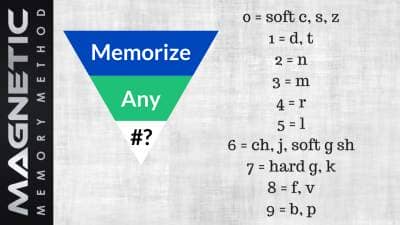
1 = d, t
2 = n
3 = m
4 = r
… and so on (see diagram for the full list.)
You use this simple formula by forming words with these numbers. For instance, 22 could be nun (formed by combining n and n). You combine these words to visualize an animated sequence of activities, which makes it difficult for you to forget!
The method can be used to memorize long digits, multiplication tables, phone numbers, number-based passwords, and so on.
>>> Yours Free: A Private Course With Cheat Sheets For Becoming A Memory Master, Starting From Scratch.
6. Using the NAME Acronym to Remember Things
The NAME acronym is a process used to remember names. However, you can use it to remember other things too. This is based on an interesting book I read recently – Boost Your Memory by Darren Bridger.
For those of you who are seriously into memorization and mastering how to remember something you forgot, it's a worthy read. Even if you're already well established, I suggest reading it for a quick review of the major principles that support remembering things.
Notice
Notice is the first word in the name acronym.
In this case, the author is not only talking about memorizing things like names by noticing the person's hair, eye color, and other distinct features of the face. He's also talking about noticing the sound of the name as part of learning to recall things better.
Seriously. Notice how the names you want to remember sound. Even a seemingly pedestrian name like "Bill" becomes quite interesting if you think about it.

You can even go so far as to pretend in your mind that you've never heard the word before. Just as we want to pay close attention to the sound of the words we are memorizing using the Magnetic Memory Method, when we learn a person's name, we want to swirl it around a bit.
It's almost like tasting wine. That's kind of a weird way to think about learning someone's name, but I've tried it out many times, and it actually does bring an interesting quality to the memorization process.
Ask And You Shall Remember
Ask is the second word in this powerful acronym that teaches you how to remember names or even information for a test.
In the case of names, Bridger is suggesting that we ask for the name to be repeated if we haven't heard it the first time. When it comes to how to memorize things for a test, it's really the same process.
For example, I'm sure you've had this experience:
You hear someone's name, but don't quite catch it. Instead of asking for it to be repeated, you let the name issue drop and hope it will come up again …
But It Never Does!
And so, as Bridger suggests, there's no shame in asking for a name to be repeated. Likewise when you study: there's nothing wrong with going back and repeating the information. And then add the act of asking with this quick tip:
If you want to remember things better, start asking people about their names. Like this:
"That's an interesting name. Where does it come from?"
These are perfect questions to ask a person. Questions like these will not only increase your rapport with the person but also cause you to pay more attention to the name in the first place.
It's the same thing with any information, and you can always ask questions about any information using this formula:
- What is interesting about this?
- Why is it like this?
- How did it come to be this way?
- What if it was different?
Remember: a great deal of what memorizing things boils down to is noticing and paying attention to the target material. It also comes down to "rotating" the information in your mind by examining it from different angles.
Mention to Help Remember Things
The author uses the word "mention" for the purposes of his acronym, but usually, tips on memorizing names tell us to repeat the name we've just heard.
Memory experts are actually divided on this point. Yes, it helps the name you want to remember to sink into your memory. And yes, it tells the person that you've heard their name and that you care about knowing them. But it can still come off as rather corny.
Still, I spend a lot of time in places where the language is not my native tongue and have found repeating the names of people I meet to be an essential habit.
Pronunciations of names vary widely, and there are often subtle sounds that people will gladly correct for you once they've heard you mispronounce their name. It's only polite to make sure you can pronounce a person's name right.
Plus, pronunciation is one of the weakest points for me. I'm always working on improving it in my own memory improvement journey – largely due to being 80% deaf in my left ear.
Even though it can be a bit corny to repeat the names of people you've just met, just do it. Taking that simple step when it comes to recalling things like names is worth it in the end.
Envision
Here Bridger finally shows us how to bring it all together.
Envisioning is simple. It's the part of the mnemonic process where we take the visual characteristics of a face and associate the name of the person with some distinct feature.
To use Bridger's teaching, which seems pulled straight out of Harry Lorayne, let's say I meet someone named Jacob and he has rather bird-like features. All I would need to do is imagine him having the face of a Blue Jay and then imagine him puffing on a corncob pipe.
(Jay + Cob = Jacob). Simple stuff.
The only problem is …
I don't like doing it this way. I find that it makes me look at the person strangely later as I'm going through the recall process. I prefer seeing the images I create either behind the person, on their shoulder or above their head. That way, when recalling their name, I'm not looking all screwy-eyed at them.
The Missing Memory Step
Plus, there's a missing step.. "Envisioning" is one thing. Having a place to find what you envisioned quite another.
That's why I've had at times dedicated Memory Palaces just for names.
If I meet a person named Jacob and see him as a Blue Jay smoking a corncob pipe. But I don't want to let the association just float around in the void. I want to Magnetize it somewhere. To do that, I put the Magnetic Imagery in a Memory Palace.
Later, when I want to recall his name, the association will come much faster than it would have otherwise.
Why? Because memory no longer needs to hunt for the association or "envisioned" information. When we associate without placing our associations somewhere, we often have an "uhhhhhhm" moment where we're searching for the association we know that we've created.
Plus, without a Memory Palace, we have no means of performing Recall Rehearsal. We will find the imagery in our Memory Palace later, but still have to reverse-engineer it in order to get the target material.
That's the key: always locate your material somewhere and then use that Memory Palace to rehearse the information into long-term memory.
How To Remember Things Through Lifestyle Changes
Your lifestyle and habits have a significant impact on your memory. These are not memory tricks. However, implementing these lifestyle changes will boost your overall ability to remember things.
7. Getting Adequate Sleep will Help you Remember Things
One of the biggest mistakes that students make is trying to study longer hours by skipping on sleep. What they forget is that sleep deprivation affects several cognitive abilities, including memory.
This should hardly be a surprise. In addition to affecting the mind, lack of sleep is also considered to be a risk factor for heart disease, cancer, diminished immunity, obesity, and several other complications.
Numerous studies have established that sleep helps in the second stage of memory – consolidation.
And there's no doubt about it:
Sleep helps in recalling facts and information as well as in procedural memory formation – the aspect of memory involved in learning new skills faster (Diekelmann and Born, 2010)
And there's more to it.
Sleep also contributes to reorganizing memories, by forming stronger connections between different memories. Sleep helps the brain to link newly absorbed information with previously acquired information, which spurs creativity (Diekelmann and Born, 2010)
Other studies have indicated that lack of sleep also makes us remember things incorrectly (Diekelmann 2008). Therefore, for several reasons, getting a good night's sleep can significantly contribute to memory improvement.
8. Taking Naps will Improve Your Memory
What if you are unable to get adequate sleep? Try taking naps.
David Dinges (University of Pennsylvania) concluded from sleep experiments supported by NASA that naps help in boosting working memory.
Dinges also says that working memory "involves focusing attention on one task while holding other tasks in memory … and is a fundamental ability critical to performing complex work." Another study concluded that a nap as short as six minutes can help boost memory (Lahl et al 2008)
9. Foods that Boost Your Memory
When we talk about diet, the conversation is usually about weight loss, improving immunity, or preventing diseases. However, what we eat also has an effect on memory improvement.
There are several foods that are great for memory such as walnuts, green tea, blueberries, fish, whole grains, olive oil, etc. – often referred to as the Mediterranean diet.
Studies have demonstrated that consumption of green tea leads to enhanced activity in the brain's prefrontal cortex (Schimdt et al 3888). This optimization leads to improved memory and better cognition overall (Feng et al 438).
Fish, walnuts, pumpkin seeds, oysters are all excellent sources of Omega-3s, which lowers the risk of dementia and Alzheimer's by as much as 47% (Schaefer et al 1545).
Incidentally, the Mediterranean diet is also recommended for preventing cancer, diabetes, cardiovascular disease, etc. Therefore, there are plenty of reasons besides memory improvement to include these foods in your diet!
You should also avoid foods that contain too much saturated fats and trans-fats such as red meat, butter, etc. Foods that cause cholesterol leading to heart attack or stroke also lead to memory impairment.
10. Exercising Leads to Memory Improvement
Exercising is another great way to improve your memory.

It's well known that exercise leads to increased blood flow to the brain, which has several cognitive benefits, such as alertness, better concentration, more positive mood, and so on.
Exercising also improves memory by releasing cathepsin B. It's a protein that triggers the growth of neurons and forms new connections in the hippocampus, a section of the brain playing a vital role in memory.
Memory improvement necessarily doesn't require rigorous exercise. Just 150 minutes of walking every week has been known to improve memory.
11. Socializing for Stronger Memories
Australian researchers conducted a study involving 700 participants over 15 years. The researchers concluded that maintaining close relationships helps in improving memory. Other studies have also indicated that socializing helps prevent memory loss through dementia and Alzheimer's disease.
Since better relationships are also linked to happiness and improvement in a number of health parameters, it's a great reason to invest more in your current relationships as well as get back in touch with people you haven't spoken to for years.
12. New Stimulating Hobbies Will Improve Your Memory
Columbia University researchers have found that people having more than six hobbies have a 38% lower chance of developing dementia. Researchers at Berkeley, California also found that people who regularly engage in activities that stimulate their brains avoid the formation of a protein that causes Alzheimer's.
The key is to pick up new hobbies that force you to expand the capabilities of your mind.
For example, you could:
- Read a book on a topic that you are completely unfamiliar with
- Learning a new musical instrument or a new dance form
- Pick up a new form of exercise,
- Regularly meet new people
The key here is to engage in activities that lead to the formation of new neurons in the brain as well as new connections between existing neurons. This helps maintain the brain's cognitive reserve – its ability to avoid memory loss.
13. Learning a New Language Boosts Memory
There are several reasons why learning a new language is great for memory.

The process of remembering vocabulary, phrases, and grammar rules all exercise your brain cells. Mental exercise like this leads to overall memory improvement. Studies have indicated that bilingual people are at less risk of Alzheimer's.
You also develop renewed curiosity about everything around you, which helps you to focus more on everyday activities and objects. As I have pointed out earlier, focus is another factor that helps us to remember things better.
Remembering is an essential skill that you have to pick up while learning any new language. When you are actively looking for ways to remember, you pick up lots of memorization techniques – which in turn improve your memory.
It's a cycle that helps you to keep improving continuously. So why not spend a few minutes every day in brushing up your French or Spanish or pick up a completely new language like Mandarin!
14. Do More Challenging Work
Studies have found that people who do more mentally challenging work are less likely to develop Alzheimer's. Working on things that are mentally taxing keeps your neurons on their toes and prevents them from deteriorating over time.
If you are in a job you find boring or if changing careers is not an option, developing better memory and a healthier brain is its own reward. You could also ask your boss to give you additional responsibilities every day that place you out of your comfort zone – so that your cognitive abilities stay in peak shape.
>>> Yours Free: A Private Course With Cheat Sheets For Becoming A Memory Master, Starting From Scratch.
15. Positivity Promotes Memory Improvement
A 2012 study indicated that feelings of positivity have a beneficial effect on remembering things in the case of older adults. Positive thinking and happiness are believed to trigger the release of dopamine in the memory-related regions of the brain, which stimulates memory formation and retention.
Try to engage in activities that make you happy. It can be as simple as setting aside 10 minutes a day to revive a hobby that you used to enjoy, such as reading or singing.
Using memory tricks definitely makes me happy, and research by Tim Dalgliesh shows how and why. In "Method-of-Loci as a Mnemonic Device to Facilitate Access to Self-Affirming Personal Memories for Individuals With Depression," he shows precisely how and why using a memory technique relieves mental anguish and creates more joy.
You can also practice positive visualization or meditation. Both of these activities reduce stress and release dopamine in the brain. Practicing gratitude also makes us happier and helps improve our memories.
>>> Yours Free: A Private Course With Cheat Sheets For Becoming A Memory Master, Starting From Scratch.
16. Meditation for Memory
Meditation is the most effective way of improving the ability of our mind to pay attention to tasks – which is important for improving retention and converting short-term memory into long-term memory.
Studies have demonstrated that practicing meditation improves our ability to focus on smaller details. (Maclean et al. 2010). Other studies have shown that mindfulness meditation works better as a memory technique than yoga. (Quach et al 2015).
Building a habit of meditating every day isn't too hard.
What if the thought of sitting still for even a couple of minutes is too painful?
Try walking meditation. Lots of people find this approach far easier than the regular sitting meditation approach, and as effective as calming the mind.
Other Memory Tricks To Remember Things
Improving your memory is also possible by approaching the process of learning something new a bit differently. Making these small additional changes can go a long way in helping you remember things.
17. Learn in the Afternoon
Research indicates that the afternoon is the best time to study to maximize recall, not necessarily when you are feeling the most alert. If your work involves any sort of learning, try to schedule it during the afternoon hours.

18. Recall Before Writing
Everyone remembers how school teachers asked us to write things down to help us remember. Adding a step to this age-old practice helps us remember things even better.
If you just mechanically write something down, you are likely to forget it soon.
Actively recall each item you wish to remember and then write it, as opposed to just copying something without thinking about it. Repeating this process multiple times is great for adding things to your long-term memory.
A useful hack to remember things that you read is to summarize a page or a paragraph in the margin of the book as you read along. This reinforces absorption into your memory, as well as helps you quickly remember the contents of the page when you look it up in the future.
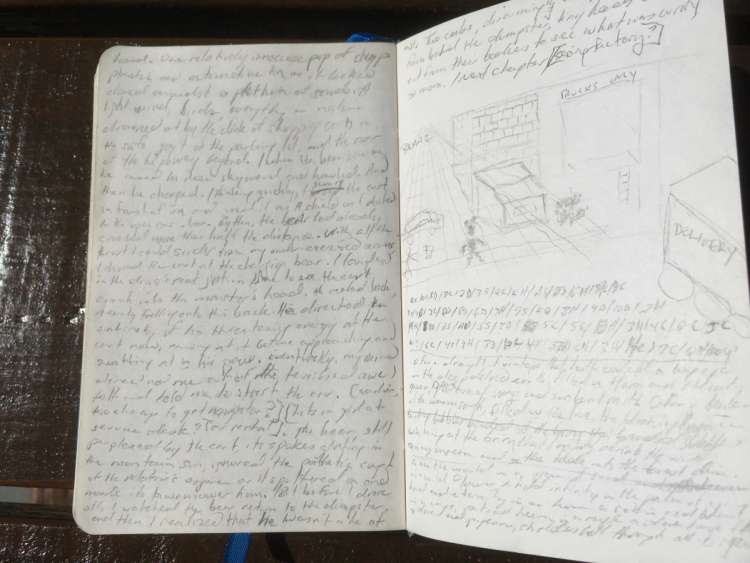
Finally, remember that writing something down is far more effective than typing it out because it helps you pay more attention to the moment. The reticular activating system is a section of your brain that gets stimulated when you do something with higher levels of alertness and lowers your chance of forgetting things.
19. Be More Interested
It's always easier to remember things that we are interested in. For instance, you might find it far easy to remember personal details of your favorite celebrity, but you tend to forget historical facts or the names of your in-law's friends!
But how do you apply this memorization technique to areas that you are not so interested in?
By actively trying to find reasons to be interested. Remind yourself regularly about why it's important to remember – how will it contribute to your personal or professional life? That will signal to your brain the importance of the topic and it will dedicate more resources to strengthening neurons that reinforce those memories.
20. Pay More Attention
Out of all the best memorization techniques for remembering things, this might be the most effective.
Researchers from MIT have identified a neural circuit in the human brain that helps in forming long-term memories. This circuit works best when your mind pays close attention to the task at hand. Essentially, higher concentration automatically leads to better absorption in the brain and helps in converting short-term memories into long-term memories.
Unfortunately, concentration is becoming an increasingly rare trait in a world where people are bombarded with an infinite number of distractions from multiple digital devices, and multitasking is the norm. However, there are two simple steps that will help improve your concentration – and hence boost your memory.
First, gradually reducing the use of digital devices will improve your attention span and free you from Digital Amnesia. Next, try doing one thing at a time and avoid switching between tasks every few minutes.
Simply building these two habits will help you to remember things more easily.
21. Visualizing Helps You Remember
A simple way of remembering tasks that you need to do is by visualizing yourself doing that action. This is especially useful when you don't have a notepad or a to-do list app with you right away, or if the process of noting down a task is too cumbersome. This is useful in several situations, but here are the two most common ones.
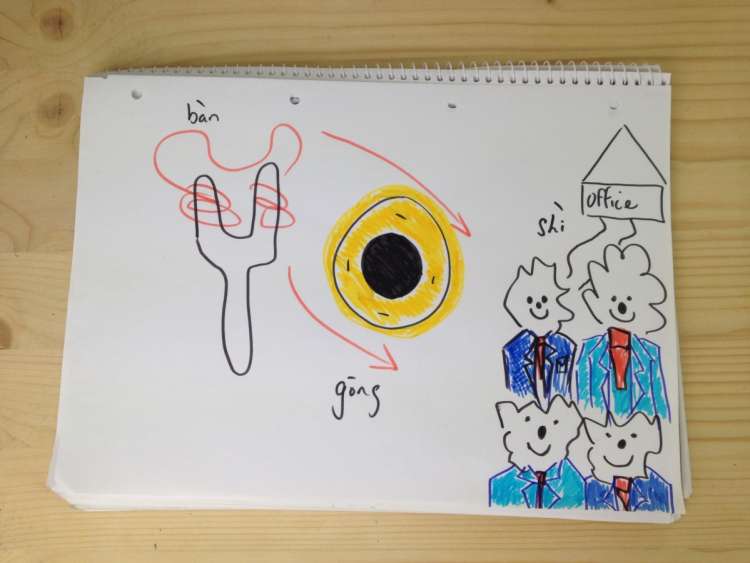
The first is in the middle of a conversation. Paying complete attention to someone speaking, is also a positive step in building rapport, and whipping out your phone to note down a task can be a distraction.
The second is remembering where you have kept something, like your glasses. Quickly visualizing it will help you recall where it is.
Visualizing to remember things doesn't eliminate the need for a to-do list, but it serves as a useful complement.
Remembering Things Isn't Hard!
We have covered a wide range of methods that will help you to remember. You don't need to practice all of them. Just picking up a few of these memorization techniques will make a substantial difference to your memory.
And what if you wanted to learn just one method that will make a huge difference to your memory? I recommend the Memory Palace. Click here to learn more about how to effectively create and use one – fast.
Then create and use more Memory Palaces. It's good for the health and longevity of your brain!
Source: https://www.magneticmemorymethod.com/how-to-remember-things/
0 Response to "Easy Trick for Remembering"
Post a Comment