How Would You Know if You Had a Stomach Perforation
Gastrointestinal perforation
Intestinal perforation; Perforation of the intestines; Gastric perforation; Esophageal perforation
Perforation is a hole that develops through the wall of a body organ. This problem may occur in the esophagus, stomach, small intestine, large intestine, rectum, or gallbladder.
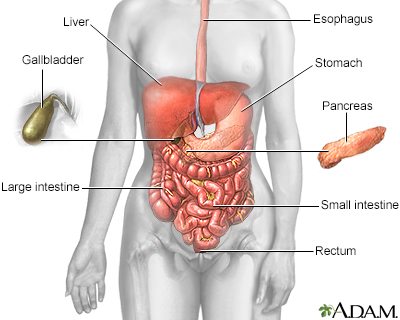
The esophagus, stomach, large and small intestine, aided by the liver, gallbladder and pancreas convert the nutritive components of food into energy and suspension down the not-nutritive components into waste product to exist excreted.
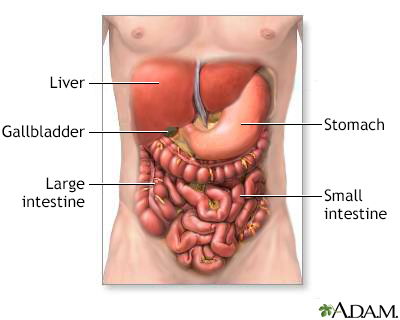
The digestive organization organs in the abdominal cavity include the liver, gallbladder, stomach, small intestine and large intestine.
Causes
Perforation of an organ can be caused by a variety of factors. These include:
- Appendicitis
- Cancer (all types)
- Crohn disease
- Diverticulitis
- Gallbladder disease
- Peptic ulcer illness
- Ulcerative colitis
- Bowel blockage
- Chemotherapy agents
- Increased force per unit area in the esophagus caused past forceful vomiting
- Ingestion of caustic substances
It may also be caused by surgery in the belly or procedures such as colonoscopy or upper endoscopy.
Symptoms
Perforation of the intestine or other organs causes the contents to leak into the abdomen. This causes a severe infection called peritonitis.
Symptoms may include:
- Severe intestinal hurting
- Chills
- Fever
- Nausea
- Vomiting
- Shock
Exams and Tests
X-rays of the chest or abdomen may show air in the intestinal cavity. This is chosen free air. It is a sign of a tear. If the esophagus is perforated free air can be seen in the mediastinum (around the heart) and in the chest.
A CT scan of the abdomen oftentimes shows where the hole is located. The white claret cell count is often higher than normal.
A procedure may help find the area of the perforation, such every bit an upper endoscopy (EGD) or a colonoscopy.
Treatment
Treatment most often involves emergency surgery to repair the hole.
- Sometimes, a small part of the intestine must be removed. One cease of the intestine may be brought out through an opening (stoma) made in the abdominal wall. This is chosen a colostomy or ileostomy.
- A drain from the abdomen or other organ may also exist needed.
In rare cases, people can exist treated with antibiotics alone if the perforation has closed. This can exist confirmed by a physical exam, blood tests, CT browse, and ten-rays.
Outlook (Prognosis)
Surgery is successful about of the time. However, the consequence volition depend on how astringent the perforation is, and for how long it was present earlier treatment. The presence of other illnesses can as well affect how well a person volition exercise after treatment.
Possible Complications
Even with surgery, infection is the most common complexity of the status. Infections tin be either within the abdomen (intestinal abscess or peritonitis), or throughout the whole body. Body-broad infection is called sepsis. Sepsis can be very serious and tin can lead to death.
When to Contact a Medical Professional
Call your health care provider if you accept:
- Blood in your stool
- Changes in bowel habits
- Fever
- Nausea
- Severe abdominal pain
- Vomiting
- Call 911 correct abroad if you or someone else have ingested a caustic substance.
Call the local poison control center emergency number at ane-800-222-1222 if a person has ingested a caustic substance. This hotline number will let you talk to experts in poisoning.
DO Not expect until the person has symptoms before you phone call for help.
Prevention
People volition ofttimes have a few days of pain before the intestinal perforation occurs. If you have pain in the abdomen, run across your provider right away. Treatment is much simpler and safer when it is started before the perforation occurs.
References
Matthews JB, Turaga K. Surgical peritonitis and other diseases of the peritoneum, mesentery, omentum, and diaphragm. In: Feldman Yard, Friedman LS, Brandt LJ, eds. Sleisenger and Fordtran'southward Gastrointestinal and Liver Disease. 11th ed. Philadelphia, PA: Elsevier; 2021:chap 39.
Squires R, Carter SN, Postier RG. Acute abdomen. In: Townsend CM Jr, Beauchamp RD, Evers BM, Mattox KL, eds. Sabiston Textbook of Surgery. 20th ed. Philadelphia, PA: Elsevier; 2017:chap 45.
Wagner JP, Chen DC, Barie PS, Hiatt JR. Peritonitis and intraabdominal infection. In: Vincent J-L, Abraham E, Moore FA, Kochanek PM, Fink MP, eds. Textbook of Critical Care. 7th ed. Philadelphia, PA: Elsevier; 2017:chap 99.
Version Info
Terminal reviewed on: 5/27/2020
Reviewed by: Jenifer M. Lehrer, MD, Section of Gastroenterology, Aria - Jefferson Health Torresdale, Jefferson Digestive Diseases Network, Philadelphia, PA. Review provided by VeriMed Healthcare Network. Too reviewed past David Zieve, Doctor, MHA, Medical Director, Brenda Conaway, Editorial Director, and the A.D.A.M. Editorial team.

Source: https://www.mountsinai.org/health-library/diseases-conditions/gastrointestinal-perforation
0 Response to "How Would You Know if You Had a Stomach Perforation"
Post a Comment